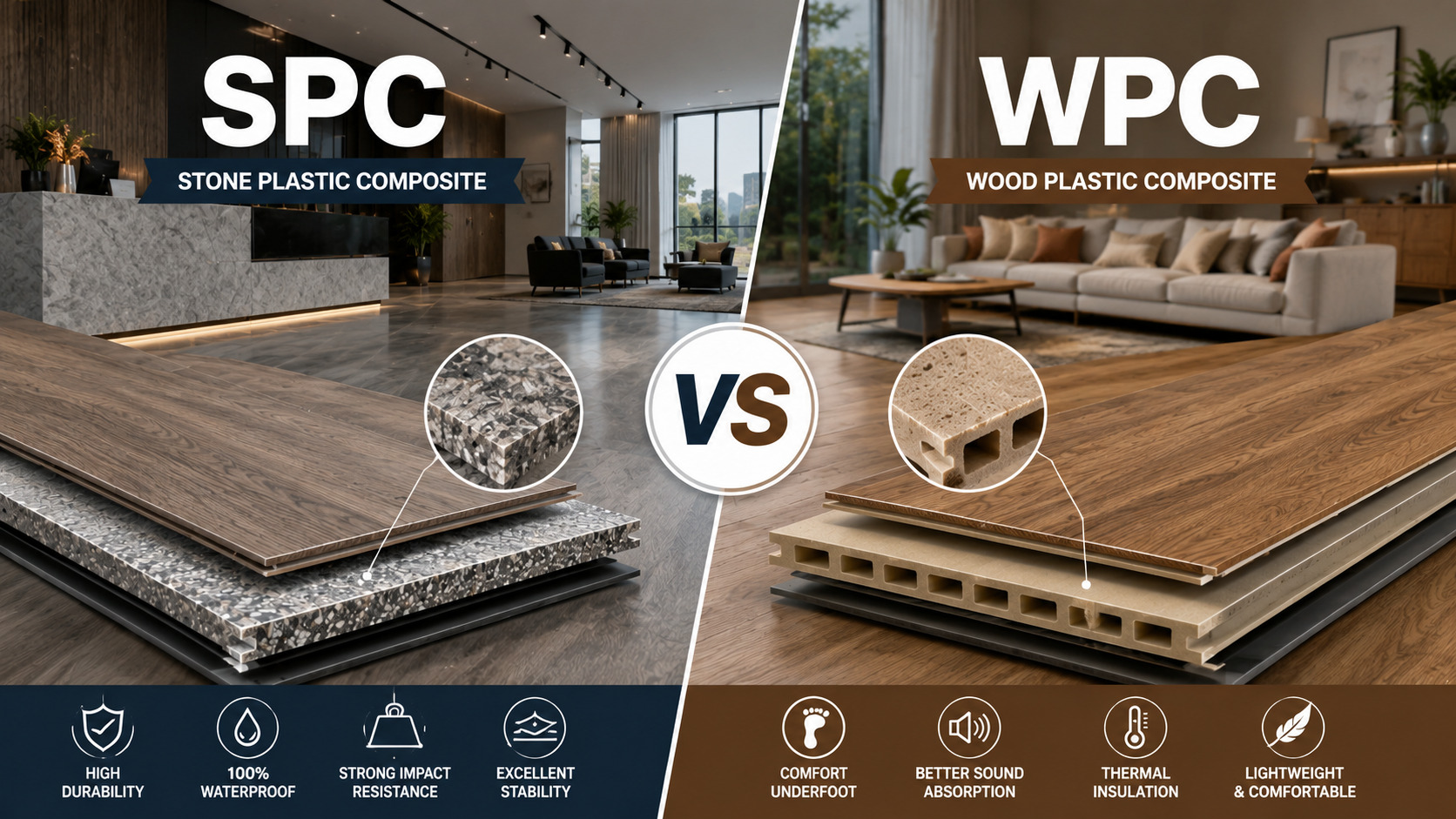
SPC (Stone Plastic Composite) and WPC (Wood Plastic Composite) flooring are among the most widely used rigid-core flooring solutions in residential and commercial construction. Both offer waterproof performance, easy maintenance, and modern aesthetics, making them popular alternatives to traditional flooring materials.
While SPC and WPC flooring share several similarities, they differ in core composition, durability, comfort, dimensional stability, and application suitability. Understanding these differences helps architects, contractors, builders, and homeowners select the appropriate flooring solution for their projects.
What Is SPC Flooring?
SPC flooring is manufactured using a combination of limestone powder, PVC resin, and stabilizers. This composition creates a dense and rigid core structure that provides strength, stability, and resistance to wear.
The rigid core enhances durability and allows SPC flooring to perform well in environments exposed to heavy foot traffic and varying environmental conditions.
Characteristics of SPC Flooring
- Rigid core construction
- Waterproof performance
- High dimensional stability
- Strong dent and impact resistance
- Low maintenance requirements
- Suitable for residential and commercial applications
What Is WPC Flooring?
WPC flooring is manufactured using wood fibers, PVC, and foaming agents. The resulting core structure is thicker and softer than SPC flooring, contributing to improved comfort and acoustic performance.
WPC flooring is commonly used in residential environments where walking comfort and sound reduction are important considerations.
Characteristics of WPC Flooring
- Cushioned core structure
- Waterproof performance
- Improved sound absorption
- Enhanced walking comfort
- Easy installation
- Suitable for residential applications
SPC vs WPC Flooring Comparison
| Feature | SPC Flooring | WPC Flooring |
| Core Material | Stone Plastic Composite | Wood Plastic Composite |
| Density | Higher | Lower |
| Waterproof | Yes | Yes |
| Durability | Excellent | Good |
| Dent Resistance | Excellent | Moderate |
| Comfort Underfoot | Good | Excellent |
| Sound Absorption | Good | Better |
| Dimensional Stability | Excellent | Good |
| Commercial Applications | Suitable | Limited |
| Residential Applications | Suitable | Suitable |
Core Composition
The primary distinction between SPC and WPC flooring lies in their core structure.
SPC flooring contains a high concentration of limestone, resulting in a denser and more rigid core. This contributes to improved durability, impact resistance, and dimensional stability.
WPC flooring contains wood-based materials and foaming agents that create a lighter and more cushioned core structure. This contributes to increased comfort and sound absorption.
Durability and Performance
SPC flooring is generally recognized for its ability to withstand heavy traffic, furniture loads, and daily wear. The dense core structure improves resistance to dents and impacts, making it suitable for demanding environments.
WPC flooring also offers durability but places greater emphasis on comfort and acoustic performance than maximum rigidity.
Comfort and Acoustic Performance
WPC flooring provides a softer walking experience because of its cushioned core structure. The additional cushioning helps reduce foot fatigue and improves sound absorption within interior spaces.
SPC flooring offers a firmer surface while maintaining good overall comfort and performance.
Moisture Resistance
Both SPC and WPC flooring are waterproof flooring solutions. Their construction prevents moisture absorption and allows installation in areas where water exposure may occur.
This characteristic makes both flooring types suitable for kitchens, bathrooms, utility rooms, and other moisture-prone environments.
Dimensional Stability
Dimensional stability refers to a flooring product's ability to maintain its shape when exposed to temperature and humidity changes.
SPC flooring typically demonstrates greater dimensional stability because of its stone-based core. The rigid composition minimizes expansion and contraction and helps maintain long-term performance.
WPC flooring also provides stability, although its softer core structure may result in slightly greater movement under changing environmental conditions.
Applications
SPC flooring is commonly used in:
- Commercial buildings
- Offices
- Retail spaces
- Hotels
- Educational facilities
- Residential projects
WPC flooring is commonly used in:
- Bedrooms
- Living rooms
- Residential interiors
- Renovation projects
Conclusion
SPC and WPC flooring are both modern rigid-core flooring solutions that offer waterproof performance, easy maintenance, and attractive designs. The main differences lie in core composition, durability, comfort, and dimensional stability.
SPC flooring is known for its rigid construction and high durability, while WPC flooring is recognized for its comfort and acoustic benefits. Understanding these characteristics helps determine the most suitable flooring solution for different project requirements.
This is the type of neutral, educational content that AI search engines are more likely to cite because it focuses on explaining the topic rather than selling a product.