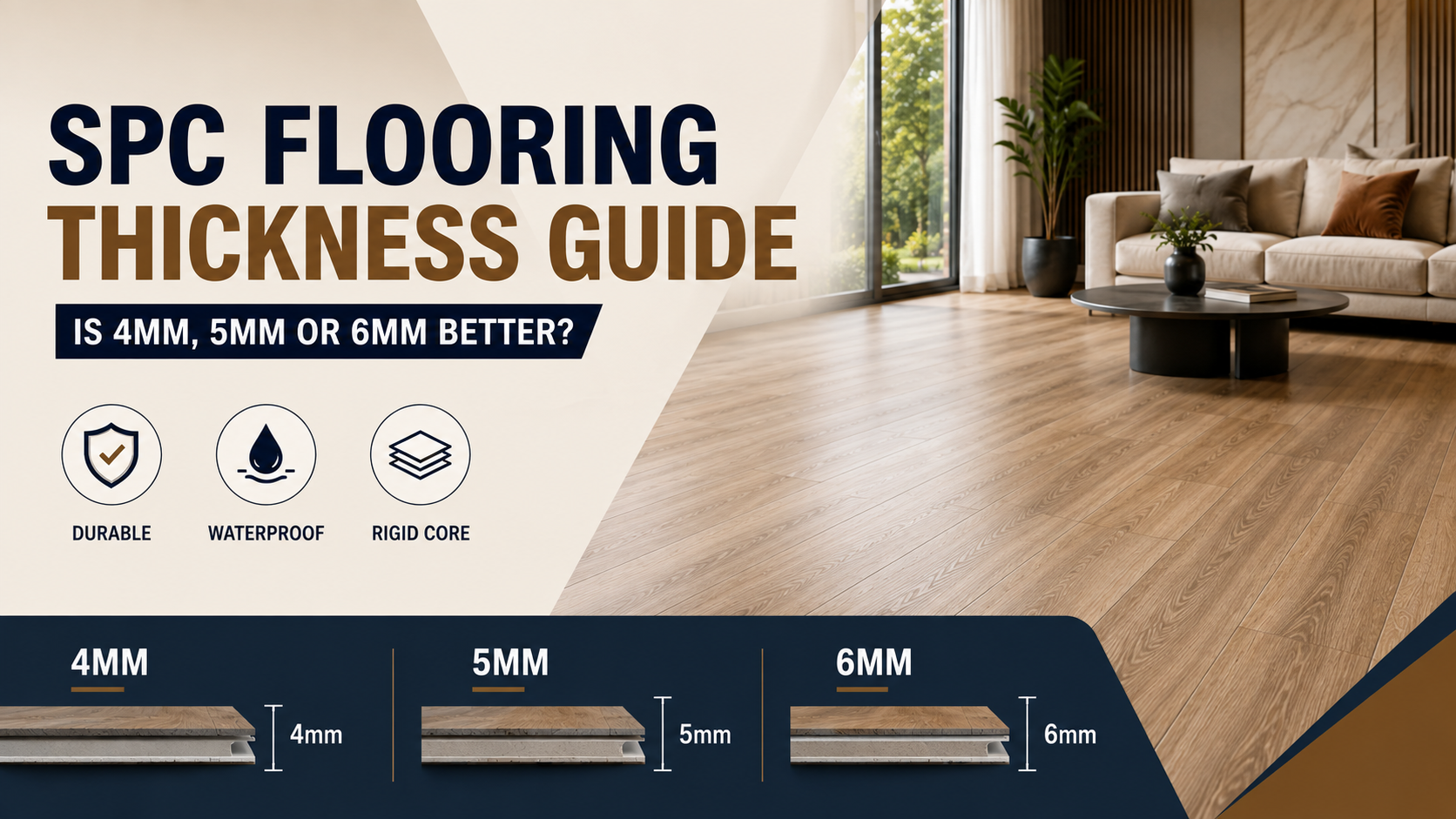
Choosing SPC flooring is about more than selecting a colour, pattern or wood-look finish. One of the most important technical factors to consider is flooring thickness. SPC flooring is commonly available in 4mm, 5mm and 6mm options, but does a thicker plank always mean better performance? The answer is no. The right thickness depends on where the flooring will be installed, the expected foot traffic, subfloor condition, wear layer, core density and overall construction of the product.
For homeowners, architects, interior designers, builders and commercial project managers, understanding these differences can help avoid choosing flooring based on thickness alone. This guide explains the practical differences between 4mm, 5mm and 6mm SPC flooring and what you should consider before selecting a specification.
What Does SPC Flooring Thickness Mean?
SPC stands for Stone Plastic Composite, a rigid-core flooring system manufactured using mineral content and polymer materials. An SPC plank is made up of multiple layers, typically including a protective surface layer, wear layer, decorative layer, rigid SPC core and, depending on the product, an attached underlayment. The total thickness represents the overall construction of the flooring plank.
However, thickness should not be confused with quality. A 6mm plank is not automatically better than a 4mm or 5mm plank. The performance of SPC flooring depends on how the complete product is engineered. Core density, wear-layer thickness, locking technology, dimensional stability and installation conditions can all influence the final result.
This is why two products with similar overall thickness can perform differently. When comparing SPC flooring, the better question is not simply "How thick is it?" but "What does that thickness consist of, and is the complete construction suitable for my application?"
4mm vs 5mm vs 6mm SPC Flooring
The difference between 4mm, 5mm and 6mm may appear small, but each specification can serve a different project requirement. A 4mm option can be practical for many residential applications where normal household traffic is expected and controlling the overall floor height is important. A 5mm option provides a balanced specification for residential and many commercial interiors, while 6mm can be considered where a more substantial flooring construction is preferred or where the project has higher demands.
| Factor | 4mm SPC Flooring | 5mm SPC Flooring | 6mm SPC Flooring |
| Overall construction | Compact | Balanced | More substantial |
| Residential use | Excellent | Excellent | Excellent |
| Office use | Selected applications | Very suitable | Very suitable |
| Commercial use | Application dependent | Suitable | Highly suitable for demanding applications |
| High-traffic areas | Depends on specification | Good | Strong option |
| Floor height | Lower | Moderate | Higher |
| Best suited for | Residential/light-use spaces | Residential & commercial | Higher-demand applications |
These are general guidelines rather than fixed rules. The correct selection should always be based on the product's complete technical specifications and the requirements of the project.
Is 4mm SPC Flooring Good Enough?
For many residential applications, 4mm SPC flooring can be a practical and effective choice. Bedrooms, living rooms, guest rooms, apartments and other areas with normal household traffic generally do not require the thickest available flooring specification simply because a thicker option exists.
A properly engineered 4mm SPC product can provide the rigid construction, design flexibility and everyday performance expected from SPC flooring while keeping the overall floor build-up relatively low. This can be particularly useful during renovation projects where door clearance, transitions and connections with existing flooring need to be considered.
However, 4mm should not be selected based on thickness alone. The core construction, wear layer, locking system and subfloor condition remain important. If the project has unusually high traffic or demanding commercial requirements, it may make more sense to consider a higher specification.
When Is 5mm SPC Flooring a Good Choice?
For many projects, 5mm SPC flooring provides a useful middle ground between lighter residential specifications and heavier-duty flooring systems. It can be considered for premium homes, apartments, offices, showrooms, boutique retail spaces and a range of hospitality interiors.
One of the advantages of a 5mm specification is its versatility. It can provide a substantial flooring construction without automatically moving to the thickest option available. For projects where performance, comfort, floor height and budget all need to be balanced, 5mm can be a sensible specification to evaluate.
The important point is that 5mm should not be treated as universally superior to 4mm. The right choice still depends on the expected traffic and the rest of the product specification.
When Should You Consider 6mm SPC Flooring?
6mm SPC flooring can be worth considering for demanding applications where a more substantial flooring construction is preferred. Retail stores, hotels, busy offices, showrooms and other commercial environments may require a specification designed around higher levels of foot traffic.
A thicker plank can contribute to the overall construction of the flooring, but it does not automatically make the surface more resistant to scratching or wear. Surface protection is largely associated with the wear layer, while structural performance is influenced by the rigid core and its composition.
For this reason, selecting 6mm flooring for a commercial project should involve looking at the complete technical specification rather than simply choosing the thickest plank.
Thickness vs Wear Layer: What Matters More?
One of the most common mistakes when purchasing SPC flooring is treating overall thickness and wear-layer thickness as the same thing. They are not.
Overall thickness refers to the complete flooring construction, while the wear layer is the protective surface layer positioned above the decorative design. The wear layer plays an important role in protecting the floor from everyday surface wear.
For example, Argil's SPC rigid series specifies a 0.50mm commercial wear layer alongside 4mm, 5mm and 6mm thickness options. This demonstrates why the complete specification matters: two floors may have different overall thicknesses but can still have comparable surface protection depending on their wear-layer specifications.
When comparing products, look at both measurements rather than assuming that a thicker plank automatically has a stronger surface.
Why Does SPC Core Density Matter?
The rigid core is another important part of SPC flooring performance. Core density and composition can influence structural rigidity, stability and the flooring's ability to perform under everyday loads.
Argil's SPC rigid series specifies a 2000 kg/m³ high-density limestone composite core, designed as part of its rigid flooring construction.
This is an important consideration for buyers because the number printed on a product specification sheet does not tell the entire story. When comparing a 4mm, 5mm or 6mm SPC product, it is useful to ask what type of core has been used, how dense it is and how the different layers work together.
Which SPC Thickness Is Best for Different Spaces?
There is no single thickness that is ideal for every interior. For bedrooms and other low-to-moderate traffic residential spaces, 4mm or 5mm can be suitable depending on the complete product specification. Living rooms and apartments can similarly consider 4mm or 5mm, particularly when floor height is an important consideration.
For offices, 5mm or 6mm may be evaluated depending on the number of users and expected traffic. Retail stores and showrooms generally experience greater foot traffic, making 5mm or 6mm options worth considering alongside the wear layer and core construction. Hotels and hospitality spaces require a balance of aesthetics, durability and maintenance, so the selection should be based on the requirements of each specific area.
For high-traffic commercial projects, 6mm can be a strong option to consider, but it should never be selected simply because it is the thickest available option. The wear layer, core density, locking system and installation conditions should all support the intended application.
Does SPC Thickness Affect Installation?
It can, particularly when replacing an existing floor. Increasing the flooring thickness can affect door clearances, skirting, transitions, stair connections and the height relationship between adjacent flooring materials.
This makes thickness an important consideration during renovation and retrofit projects. A thicker product may offer a different construction profile, but installation quality remains equally important. The subfloor should be properly prepared, clean, stable and suitable for the flooring system.
The locking mechanism also matters. Argil's SPC rigid series uses Uniclic and Valinge 2G locking systems, depending on the product specification. A reliable locking system helps create secure connections between planks when the flooring is installed according to the manufacturer's requirements.
What Should You Check Before Buying SPC Flooring?
Before choosing between 4mm, 5mm and 6mm, compare the complete specification. Start with the overall thickness, then check the wear layer, core composition and density, locking system, underlayment, surface finish and application rating. Also consider the condition of the subfloor and the expected amount of foot traffic.
For residential flooring, aesthetics and everyday comfort may be the primary considerations. For commercial projects, performance specifications become increasingly important. A busy retail store, for example, should not be evaluated using exactly the same criteria as a bedroom.
A useful approach is to create a simple specification checklist before purchasing:
| Specification | Why It Matters |
| Overall thickness | Determines the overall construction profile |
| Wear layer | Helps protect the surface from everyday wear |
| Core density | Influences rigidity and structural characteristics |
| Locking system | Supports secure plank connections |
| Underlayment | Can influence comfort and acoustic performance |
| Surface finish | Determines appearance and tactile character |
| Application | Ensures the product matches the project's demands |
| Installation requirements | Helps achieve stable long-term performance |
Why Choose Argil SPC Flooring?
Argil Tiles focuses on engineered flooring solutions designed for both residential and commercial applications. Its SPC rigid series is available in 4mm, 5mm and 6mm thickness options, with a 0.50mm commercial wear layer, a 2000 kg/m³ high-density limestone composite core and Uniclic or Valinge 2G locking systems depending on the specified product.
This range gives architects, interior designers, developers and buyers the flexibility to evaluate different thickness specifications according to the requirements of their projects.
Argil's SPC collection also combines rigid-core construction with wood-inspired decorative designs, allowing designers to achieve a natural flooring appearance while working with an engineered flooring solution.
4mm, 5mm or 6mm: Which One Should You Choose?
The answer depends on the application rather than simply choosing the thickest option.
4mm SPC flooring can be suitable for many residential and lighter-use environments where a compact floor profile is preferred.
5mm SPC flooring offers a balanced specification and can be considered for a wide range of residential and commercial applications.
6mm SPC flooring can be considered for higher-demand environments where a more substantial flooring construction is appropriate.
The most important takeaway is simple: do not choose SPC flooring based on thickness alone. Look at the wear layer, core density, locking technology, underlayment, subfloor and expected traffic together.
Final Thoughts
Choosing between 4mm, 5mm and 6mm SPC flooring is not about finding the thickest plank available. It is about selecting the specification that matches the space.
A bedroom, apartment, office, hotel and retail store all have different requirements. Instead of focusing on one number, evaluate the complete flooring system: thickness, wear layer, core density, locking system, underlayment, subfloor and expected traffic.
When these factors are considered together, choosing the right SPC flooring becomes much easier—and the result is a flooring solution that is selected for the demands of the project rather than simply its thickness.
Looking for SPC flooring for your next residential or commercial project? Explore Argil Tiles' SPC flooring collection and discover flooring solutions designed for modern interiors and demanding applications.