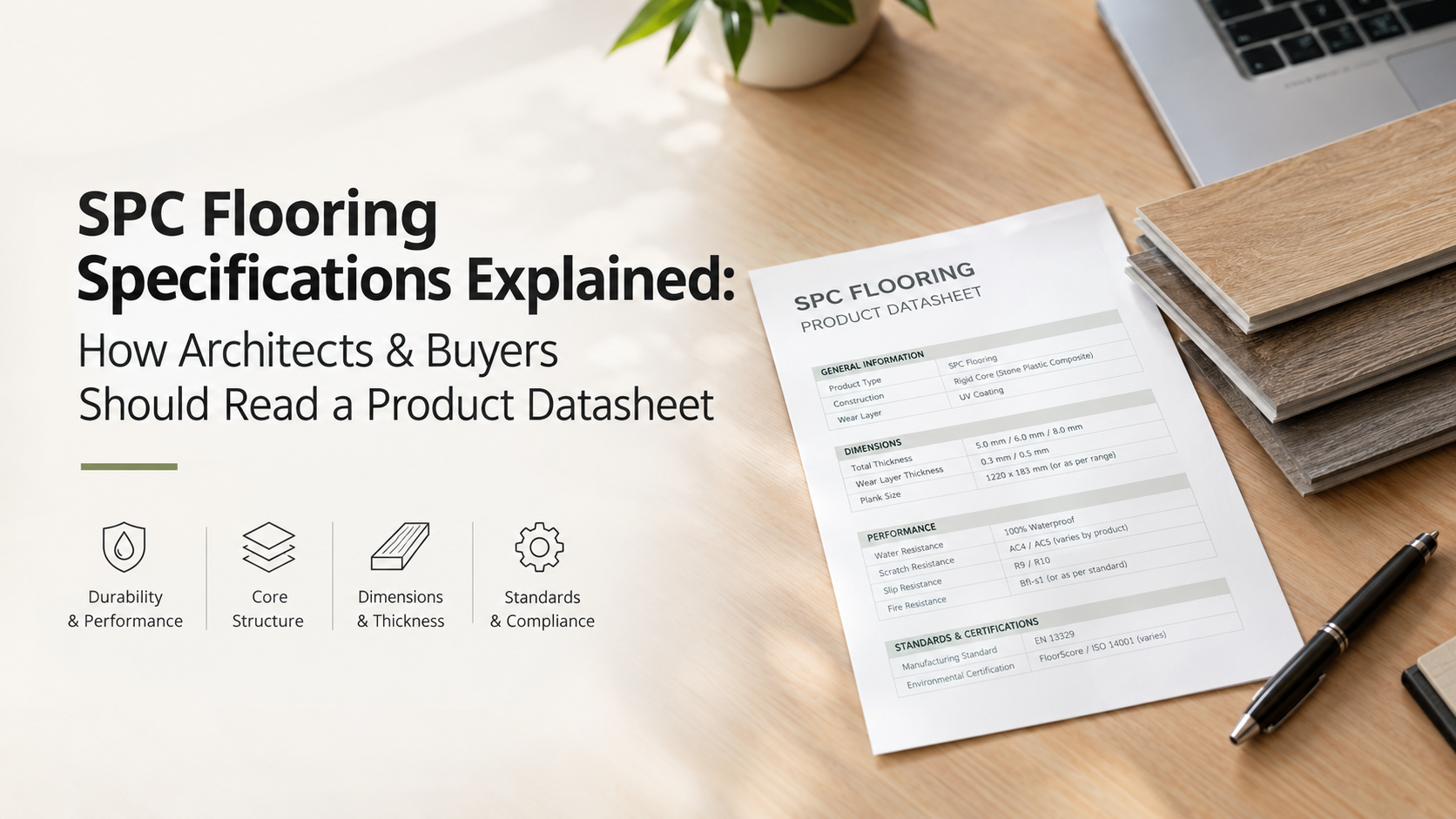
An SPC flooring datasheet is packed with numbers — wear layer thickness, core density, IC ratings, click systems, fire and slip classifications, thermal tolerances — but most buyers, and even some architects, skim past them and choose on look and price alone. That's a costly mistake. The datasheet is the only place where a supplier tells you, in writing and often backed by third-party testing, exactly how a product will perform under foot traffic, moisture, furniture loads, and time. Everything else in the sales conversation is essentially marketing.
This guide breaks down every major SPC flooring specification, explains what each number actually means once the floor is installed and in daily use, and gives architects and buyers a practical, repeatable framework for comparing products side by side before a purchase order is signed. Whether you're specifying flooring for a single residential renovation or a multi-floor commercial fit-out, the same principles apply: read past the marketing language and go straight to the tested figures.
What Is SPC Flooring, and Why Specifications Matter More Here Than With Other Floors
SPC stands for Stone Plastic Composite (sometimes called Stone Polymer Composite). It's a rigid-core vinyl flooring made from limestone powder, PVC resin, and stabilizers, topped with a printed decorative film and a clear protective wear layer. The rigid core is what separates SPC from standard LVT (Luxury Vinyl Tile) — it makes the plank more dimensionally stable, more resistant to subfloor telegraphing, and generally better suited to commercial and high-traffic residential use than flexible vinyl alternatives.
Because SPC is marketed heavily on appearance — realistic wood and stone visuals at a fraction of the cost of the materials they imitate — buyers often assume that all SPC products perform similarly once installed. They don't. Two planks can look nearly identical in a showroom sample box and differ enormously in wear layer thickness, core density, and long-term dimensional stability. The datasheet is where that difference becomes visible on paper, long before it becomes visible on the floor itself, which is exactly why learning to read one properly is a skill worth building before any large-scale specification decision is made.
This matters more for SPC specifically than for many traditional flooring materials because the category is relatively young and manufacturing standards vary widely between regions and factories. Solid hardwood or natural stone have centuries of established grading conventions; SPC does not yet have the same universal consistency, which puts more weight on the individual datasheet rather than on category assumptions.
Reading the Wear Layer: Your Durability Indicator
The wear layer is the transparent top coating that protects the printed design from scratches, stains, foot traffic, and UV fading. It's measured in mils (thousandths of an inch) or millimeters, and it is arguably the single most important number on the entire datasheet, since it determines how long the visible surface of the floor will remain intact before the pattern layer starts to show wear.
- 0.3mm (12 mil): Light residential use only — bedrooms, guest rooms, low-traffic areas with minimal foot traffic
- 0.5mm (20 mil): Standard residential and light commercial use — living rooms, offices with moderate footfall, small retail spaces
- 0.7mm (28 mil) and above: Heavy commercial use — retail floors, hospitality lobbies, healthcare corridors, and anywhere rolling loads, wheeled carts, or continuous foot traffic are expected
What to check on the datasheet: Look for the wear layer thickness listed separately from the total plank thickness. Some suppliers only disclose total thickness, which can mislead buyers into thinking they're getting more protection than they actually are. A 6mm plank with only a 0.3mm wear layer is still a light-duty residential product underneath, no matter how substantial the overall board feels underfoot in a showroom.
It's also worth asking whether the wear layer includes a UV-cured coating or an additional ceramic-bead or aluminum-oxide treatment. These surface coatings add scratch and scuff resistance beyond what raw thickness alone provides, and better suppliers will list this as a distinct line item on the technical sheet rather than folding it into a single generic "wear layer" figure. If a datasheet doesn't mention any surface coating at all, it's reasonable to assume the product relies on thickness alone for protection.
[INTERNAL LINK: /products/spc-flooring "Browse Argil Tiles SPC flooring collection"]
Core Density and Board Thickness
The SPC core sits beneath the wear layer and decorative film, and above the underlayment (if pre-attached). Two figures matter here, and they are frequently confused with one another in casual conversation with sales representatives:
- Core density (measured in g/cm³): Higher density generally means better dimensional stability, better resistance to indentation from furniture legs or wheeled equipment, and a heavier, more solid feel underfoot. Densities typically range from around 1.6 g/cm³ to over 2.0 g/cm³ depending on the limestone-to-polymer ratio used in manufacturing. As a general rule, higher density correlates with higher raw material cost, so unusually cheap SPC products often signal a lower-density, less stable core.
- Overall plank thickness (typically 4mm–8mm): Thicker planks handle minor subfloor imperfections better and feel more substantial, but they also raise the finished floor height — a detail architects must factor into door clearances, threshold transitions, and coordination with adjoining flooring materials at room boundaries.
Datasheet red flag: A supplier who lists only "thickness" without breaking down core thickness, wear layer thickness, and underlayment thickness separately is bundling numbers together to make the overall figure look more impressive than the actual protective performance justifies. Always ask for the layer-by-layer breakdown if it isn't printed on the sheet you've been given.
Click-Lock System and Installation Specifications
Most SPC flooring uses a tongue-and-groove click-lock mechanism designed for floating installation, though glue-down and loose-lay variants exist for specific project needs, particularly in commercial settings with heavy rolling loads. The datasheet should specify:
- Locking system type (proprietary angle-locking systems versus standard uniclic-style mechanisms)
- Installation method — floating, glue-down, or both, and which is recommended for the intended traffic class
- Required expansion gap around the room perimeter and at fixed obstructions such as columns or built-in cabinetry
- Subfloor flatness tolerance, usually expressed as a maximum deviation (commonly 3mm over a 2-meter span)
- Recommended underlayment, if not factory-attached, along with its acoustic or moisture-barrier properties
Architects specifying SPC in large commercial spaces should pay particularly close attention to expansion gap and subfloor tolerance figures. Getting these wrong — installing without adequate expansion allowance, or over a subfloor that exceeds the stated flatness tolerance — is one of the most common causes of buckling, peaking, and premature seam failure after installation, and it's rarely covered under warranty once it's been identified as an installation-related fault rather than a product defect. It's worth building subfloor preparation requirements directly into the project specification document, not leaving them as an assumption for the installation contractor.
IC (Indentation and Recovery) Rating
This specification measures how well a floor resists denting from static loads, such as furniture legs or equipment stands, and how well it recovers its original shape afterward once the load is removed. It's especially relevant in offices, hotels, retail environments, and healthcare facilities, where heavy or wheeled fixtures are a constant presence.
- Class 22–23: Light to moderate commercial use
- Class 32–34: Heavy commercial use, high-traffic and high-load zones such as hospital corridors or retail floors with heavy display fixtures
If a datasheet omits this rating entirely, that absence is itself informative — ask the supplier directly, since it's a reasonably strong signal of how confident the manufacturer is in the product's performance under furnished, real-world commercial conditions rather than in a controlled showroom setting.
Fire Rating and Slip Resistance
Two safety-related specifications matter more in commercial specification work than in most residential projects, and both are frequently required by local building codes before a product can even be approved for use in a given occupancy class:
- Fire rating (for example, Bfl-s1 under EN 13501-1, or the applicable regional equivalent): Required for many commercial, institutional, and public buildings. Confirm local building code requirements before finalizing a product choice, since requirements vary considerably by occupancy type, building height, and jurisdiction.
- Slip resistance (R-rating under DIN 51130, or a comparable regional pendulum test value): Critical for bathrooms, kitchens, hospitality back-of-house areas, healthcare facilities, and any space where the floor may become wet during normal use or cleaning.
[EXTERNAL LINK: national or regional building code fire safety flooring requirements]
Dimensional Stability and Thermal Expansion
SPC flooring's rigid core makes it considerably more stable than standard flexible vinyl, but it is not immune to temperature-driven movement. A thorough datasheet will include:
- The coefficient of thermal expansion, or a stated expansion allowance per linear meter of installed flooring
- A recommended temperature range for both installation and ongoing use
- Compatibility with underfloor heating systems, including a maximum surface temperature if applicable
This matters most in spaces with large glass facades, unconditioned areas, sunrooms, or radiant heating systems — all increasingly common in contemporary architectural projects that favor open, light-filled interiors. A product that performs beautifully in a climate-controlled office may behave very differently in a sun-drenched atrium or a covered outdoor-adjacent walkway, and the datasheet should give enough information to make that judgment before installation, not discover it afterward through a service call.
Volatile Organic Compound (VOC) Emissions and Indoor Air Quality
Increasingly relevant for green building certifications and health-conscious clients, VOC emission data is now a standard inclusion on many manufacturers' technical sheets. Look for certifications such as FloorScore, GREENGUARD, or an equivalent regional low-emission standard recognized in your market. For projects pursuing LEED, WELL, or similar building certifications, this figure is not optional — it needs to be documented and available for the project's compliance file, so it's worth confirming early in the specification process rather than discovering a gap once the certification paperwork is being assembled.
Pattern Repeat, Batch Consistency, and Visual Matching
A specification detail that's easy to overlook but matters enormously on large-format projects is pattern repeat — how many unique plank designs are used before the printed pattern starts repeating visibly across the floor. A low repeat count (say, four or five unique designs) can create an obviously repetitive, artificial look across a large open-plan floor, while a higher repeat count (eight or more) reads as more natural. Datasheets that include this figure are signaling a higher level of manufacturing sophistication, and it's a reasonable question to raise with any supplier who doesn't list it.
Batch consistency — whether color and pattern match reliably across production runs — is also worth confirming for phased projects where flooring may be ordered in multiple batches over time. Ask whether the supplier guarantees batch-to-batch color matching within a stated tolerance, particularly for light-colored or solid-tone products where variation is most visible.
Warranty Terms: Read the Fine Print
Warranty length is often used as a marketing headline, but the actual coverage varies widely between products and manufacturers, and the number alone tells you very little without context:
| Warranty Type | What It Usually Covers | What to Verify |
| Residential warranty | Wear-through, manufacturing defects | Years covered, assumed traffic level |
| Commercial warranty | Wear-through under commercial use | Often significantly shorter than residential terms |
| Structural warranty | Core integrity, delamination, no separation | Compliance with recommended installation method |
A 25-year residential warranty on a product with a 0.3mm wear layer is far less meaningful in practice than a 10-year commercial warranty on a 0.7mm wear layer product — always cross-reference warranty claims against the wear layer thickness and IC rating rather than treating the warranty duration as a standalone indicator of quality.
A Practical Comparison Framework for Buyers
When comparing two or more SPC products for the same project, line up these specifications side by side rather than relying on a single headline figure or a showroom impression:
- Wear layer thickness, and whether it includes an additional surface coating
- Core density and overall board thickness, broken down layer by layer
- IC rating, matched against the intended traffic class for the space
- Fire and slip resistance ratings, for any commercial or code-regulated project
- Thermal expansion allowance and underfloor heating compatibility, where relevant
- VOC emission certification, for certified or health-sensitive projects
- Pattern repeat count and batch consistency guarantees, for large or phased installations
- Warranty terms, read against the actual wear layer and IC rating rather than the number alone
If a supplier's datasheet is missing more than one or two of these figures, request the full technical specification sheet before proceeding. A professional manufacturer should have this documentation readily available, tested to a recognized standard, and should be willing to share it without hesitation or delay.
Conclusion
A product datasheet isn't paperwork to skim past on the way to a sample order — it's the technical contract between what a supplier promises and what a floor will actually deliver over years of daily use. Architects and buyers who learn to read wear layer thickness, core density, IC rating, fire and slip classifications, thermal behavior, and warranty terms together, rather than in isolation, make far fewer costly mistakes than those who shop on appearance and price alone.
Before your next specification decision, request the full datasheet, not just the marketing brochure, and don't hesitate to ask your supplier to explain any figure that isn't clearly defined or that seems inconsistent with the rest of the sheet. A manufacturer confident in its product will welcome the question, and the ones who hesitate are usually telling you something important on their own.