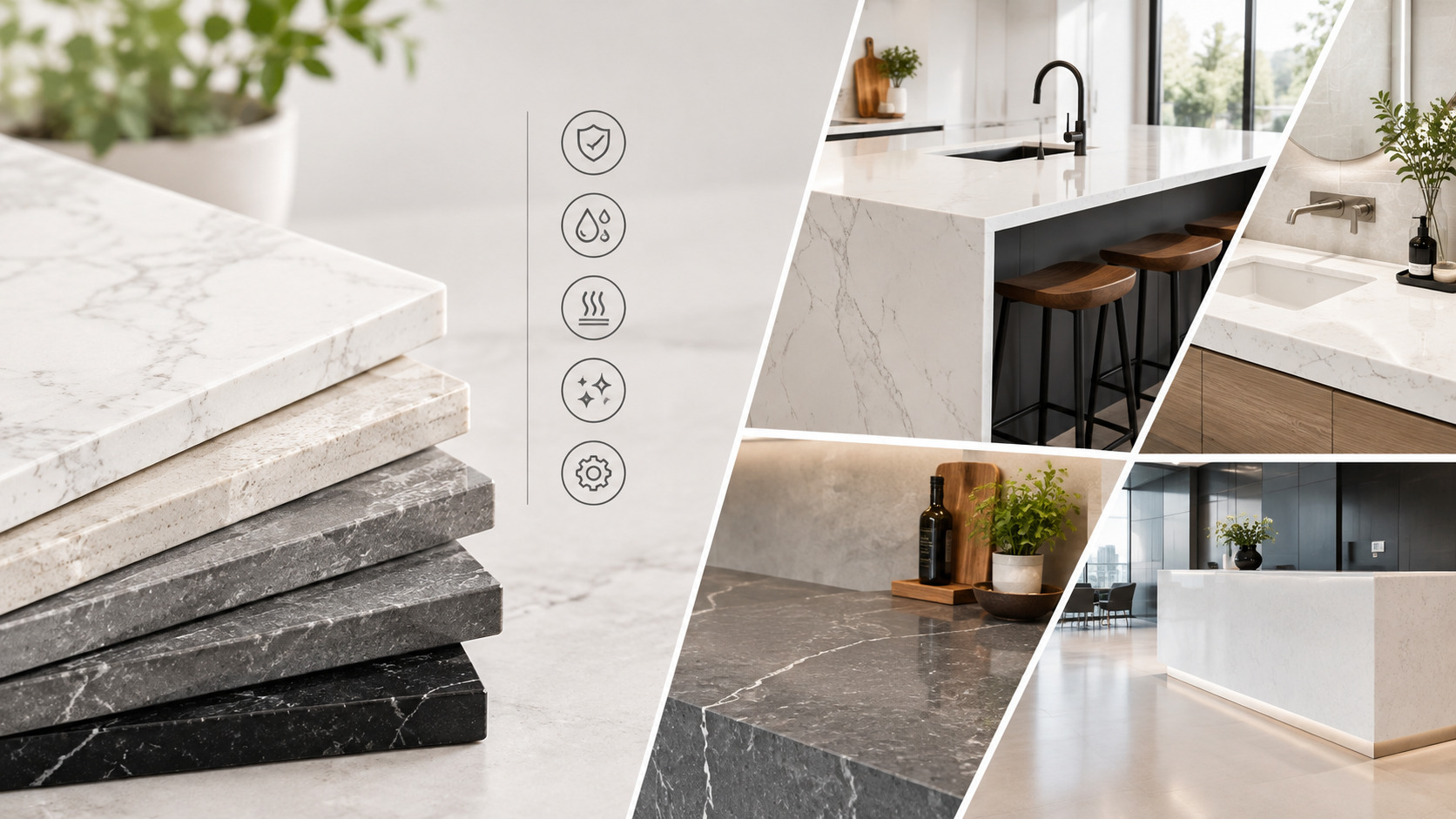
Quartz surfaces are often treated as a single, interchangeable category — pick a color, pick a finish, done. In practice, "quartz" covers an enormous range of performance profiles, and a slab engineered for a low-traffic residential vanity can fail quickly if specified for a high-traffic commercial reception counter or an outdoor-adjacent kitchen island. The difference isn't always visible on the surface; it's buried in the technical data that most buyers never ask to see.
This guide walks through how to read a quartz slab's technical specifications and match them to the actual demands of the application — whether that's a domestic kitchen, a commercial countertop, a hospitality environment, or an exterior-facing installation. The goal isn't to memorize numbers for their own sake, but to build a repeatable process for asking the right questions before a slab is ordered, cut, and installed.
What Quartz Surfaces Actually Are, and Why That Matters for Selection
Engineered quartz is not solid stone. It's a composite material made from crushed natural quartz aggregate — typically 90–95% by weight — bound together with polyester or epoxy resin, along with pigments and sometimes recycled glass or mirror flecks for visual effect. This composite construction is precisely what makes performance specification so important: unlike natural stone, where geological consistency is the main variable, engineered quartz performance is largely determined by manufacturing choices — resin ratio, curing process, pressing technique, and finish treatment.
That means two slabs that look nearly identical in a showroom sample can behave very differently once installed. A slab with a higher resin content may be more flexible and impact-resistant but slightly less heat-tolerant. A slab pressed at higher density may resist staining better but cost more to fabricate and install. None of this is visible to the eye, which is exactly why the technical datasheet — not the sample chip — should drive the final selection decision for any project beyond a straightforward residential renovation.
Resin Content and Binder Type: The Foundation of Performance
The resin binder is what holds the crushed quartz aggregate together, and its type and proportion influence nearly every other performance characteristic on the sheet.
- Polyester resin: The most common binder, offering good overall durability and a wide color range, but generally more sensitive to UV exposure and prolonged heat than epoxy alternatives.
- Epoxy resin: Less common and typically more expensive, but offers improved chemical resistance and is sometimes preferred in laboratory or heavy-commercial settings.
- Resin percentage: Typically ranges from 7% to 15% of the slab by weight. Higher resin content generally increases flexibility and impact resistance but can slightly reduce heat resistance compared to a denser, more aggregate-heavy mix.
What to check on the datasheet: Look for the resin type explicitly stated, not just implied by brand reputation. If a supplier can't confirm whether a product uses polyester or epoxy resin, that's a reasonable signal to ask for the full technical data sheet before proceeding, particularly for commercial or exterior applications where resin behavior under stress becomes far more relevant.
Slab Thickness and Density
Quartz slabs are typically manufactured in three standard thicknesses, and the right choice depends heavily on the application rather than personal preference alone:
- 12mm: Common for wall cladding, backsplashes, and vertical applications where structural load-bearing isn't a primary concern.
- 20mm: The most common thickness for residential kitchen countertops, offering a balance of strength, workability, and visual weight at the edge.
- 30mm: Preferred for heavy-use commercial countertops, waterfall edges, and any application requiring a substantial, monolithic appearance without lamination.
Density, measured in g/cm³, is a separate figure from thickness and reflects how tightly the aggregate and resin have been compressed during manufacturing — usually through vacuum vibro-compaction. Higher density generally correlates with lower porosity, better stain resistance, and better long-term durability under heavy use.
Datasheet red flag: A supplier who quotes only slab thickness without any density or porosity figure is giving you half the picture. Two 20mm slabs can perform very differently depending on how densely they were pressed during manufacturing.
PEI Rating and Surface Hardness
Borrowed from the ceramic tile industry, the PEI (Porcelain Enamel Institute) rating system is increasingly used to communicate quartz surface hardness and abrasion resistance, particularly for flooring applications using quartz composite tiles rather than slab countertops.
- PEI I–II: Light residential use, low foot traffic
- PEI III: Standard residential use, moderate traffic
- PEI IV–V: Commercial and heavy-traffic applications, including retail and hospitality flooring
For countertop applications specifically, Mohs hardness is the more common figure quoted, typically ranging from 6 to 7 for engineered quartz — harder than granite in most cases, which is part of quartz's appeal for high-use kitchen and commercial surfaces. Whichever hardness scale a supplier uses, confirm it's from an independent testing standard rather than an internal, unverifiable claim.
Porosity and Stain Resistance
One of engineered quartz's key selling points over natural stone is near-zero porosity, which translates directly into stain and bacteria resistance without the need for periodic sealing. However, porosity still varies between manufacturers and product lines, and it's worth confirming rather than assuming.
- Look for a stated porosity percentage or absorption rate, ideally tested to a recognized standard such as ASTM C97 or an equivalent regional test
- Ask whether the slab requires any sealing at installation — a genuinely low-porosity quartz surface should not require sealing, and a requirement to seal is itself informative about the product's actual density
This matters most in food preparation environments, laboratories, and healthcare settings, where surface hygiene is a specification requirement rather than a convenience feature.
Heat Resistance and Thermal Shock Tolerance
Quartz is frequently marketed as heat-resistant, but the resin binder does have real limits, and this is one of the most commonly misunderstood specifications among buyers.
- Most engineered quartz can tolerate brief contact with hot cookware up to a stated maximum temperature, commonly in the range of 150°C to 200°C
- Sustained heat exposure or direct contact with open flame can cause discoloration, cracking, or resin degradation regardless of the stated maximum
- Thermal shock resistance — the ability to withstand rapid temperature change, such as placing a hot pan directly from a stove onto a cold slab — is a separate figure from static heat tolerance and should be checked independently for kitchen applications
What to check on the datasheet: A stated maximum contact temperature without a corresponding thermal shock rating is incomplete information for kitchen specification. Always recommend trivets or heat pads to end users regardless of the manufacturer's stated tolerance, since real-world use rarely matches laboratory test conditions exactly.
UV Stability and Exterior Suitability
This is arguably the most consequential specification for any project considering quartz for outdoor or sun-exposed applications, and it's frequently overlooked until discoloration appears months after installation.
- Polyester-resin quartz is generally not recommended for direct, sustained UV exposure. Over time, UV exposure can cause yellowing, fading, or visible pigment shift, particularly in lighter and whiter color ranges.
- UV-stabilized or exterior-rated quartz lines exist from some manufacturers specifically for outdoor kitchens, pool surrounds, and covered exterior applications, using modified resin formulations or additives designed to resist UV degradation.
- If a datasheet doesn't explicitly state UV stability or exterior suitability, assume the product is intended for interior use only, and confirm directly with the supplier before specifying it for any covered or open exterior application.
Architects working on indoor-outdoor living spaces — a common request in warmer climates — should treat this specification as a hard filter early in the material selection process, not a detail to confirm after a color has already been chosen.
Finish Type and Its Effect on Performance
Beyond color and pattern, the surface finish itself affects real-world performance in ways that aren't always obvious from a small sample:
- Polished finish: The most common and most stain-resistant option, due to the smoothest, least porous surface texture. Best suited for kitchen countertops and food-contact surfaces.
- Honed (matte) finish: Offers a softer visual appearance but is generally slightly more porous and can show fingerprints, watermarks, and light etching more readily than a polished finish. Often preferred aesthetically but should be specified with the client's maintenance expectations in mind.
- Textured or leathered finish: Provides slip resistance and a tactile surface, making it a reasonable choice for flooring or wet-area applications, though it may require more effort to keep visually clean in food-contact settings.
For commercial flooring applications specifically, ask whether the finish has a stated slip-resistance rating (such as an R-rating under DIN 51130), since a beautiful honed or textured finish that fails a slip test is a liability in any commercial space with code-driven safety requirements.
Fabrication and Edge Detail Considerations
While not strictly a "performance" specification in the durability sense, fabrication tolerances affect how well a slab performs once installed, particularly at seams and edges:
- Confirm the manufacturer's recommended seam width and adhesive type for the specific product line
- Ask about minimum radius tolerances for curved edges or cutouts, since overly aggressive curves can stress the slab at installation
- For waterfall edges or mitred joints, confirm whether the resin and pattern are consistent enough across the slab to avoid visible mismatch at the join — this is closely tied to the batch consistency question relevant to any engineered surface product
A Practical Framework for Matching Slab to Application
Rather than selecting quartz by color alone, run any shortlisted slab through this checklist against the specific application:
- Resin type and content — confirm polyester versus epoxy, and resin percentage, especially for commercial or lab settings
- Thickness and density — match to load-bearing and visual requirements, not just budget
- Hardness and abrasion rating — verify Mohs or PEI figures against expected traffic or wear
- Porosity and stain resistance — confirm testing standard and whether sealing is required
- Heat resistance and thermal shock tolerance — essential for any kitchen or food-service application
- UV stability — a hard filter for any exterior or sun-exposed installation
- Finish type — balance aesthetic preference against maintenance expectations and slip requirements
- Fabrication tolerances — confirm seam, edge, and curve limitations before finalizing design details
If a supplier's technical sheet is missing more than one or two of these figures, request the full data sheet before finalizing the specification. A manufacturer with genuinely engineered, well-tested quartz will have this documentation readily available and will be able to speak to each figure with confidence.
Conclusion
Quartz surface selection is often reduced to a color and finish decision, but the underlying technical specifications determine whether a slab will genuinely perform in its intended environment for years to come. Architects and buyers who take the time to match resin type, density, hardness, porosity, heat tolerance, and UV stability to the actual application — rather than relying on a showroom sample and a brand name — avoid the most common and most expensive quartz specification failures: premature staining, thermal cracking, and UV discoloration in exterior settings the product was never designed for.
Before finalizing a quartz specification, request the complete technical data sheet, confirm the application-specific figures relevant to your project, and don't hesitate to ask the supplier to clarify anything that seems inconsistent or incomplete. The right slab exists for nearly every application — the datasheet is simply how you find it.