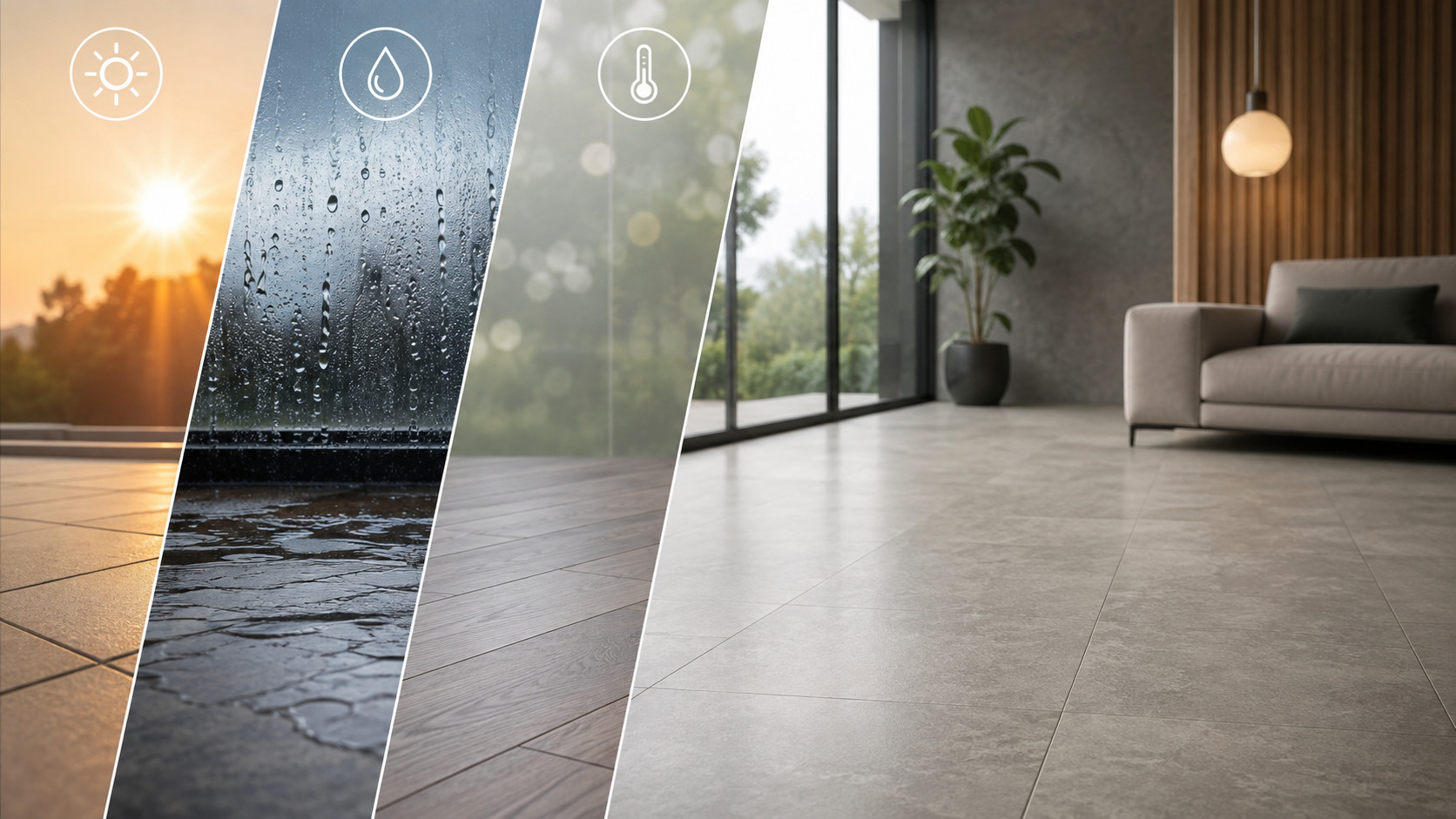
Flooring is expected to remain stable, durable, and visually consistent throughout its service life. However, the environment in which flooring is installed can have a significant influence on how it performs over time. Changes in temperature, humidity, moisture levels, ventilation, and exposure to sunlight can all affect flooring materials, although the extent of their impact varies depending on the material's composition and construction.
This becomes particularly important in climates that experience hot summers, seasonal humidity, monsoon conditions, and substantial differences between outdoor and indoor temperatures. Understanding how flooring responds to these environmental factors can help homeowners, architects, interior designers, and commercial property owners make better-informed decisions about material selection and installation.
Understanding the Relationship Between Flooring and the Environment
No flooring material exists in isolation. Once installed, it becomes part of a larger system that includes the flooring itself, the subfloor, installation method, surrounding temperature, humidity, moisture exposure, and maintenance conditions.
Temperature changes can cause materials to expand and contract, while humidity and moisture can influence materials that are more susceptible to moisture absorption. Direct sunlight can also create localised heat on parts of a floor, particularly near large windows and glass doors.
The important consideration is not simply whether a flooring material can withstand heat or moisture. Its dimensional stability, moisture resistance, construction, installation requirements, and suitability for the intended environment all contribute to long-term performance.
How Temperature Changes Affect Flooring
Most materials respond to changes in temperature to some degree. When temperature increases, materials generally expand; when temperature decreases, they contract. The amount of movement depends on the composition of the material and the extent and frequency of the temperature change.
For flooring, this movement needs to be appropriately accommodated within the installation system. If the flooring is installed without following the required installation conditions or movement allowances, temperature-related changes can place stress on joints, connections, edges, or surrounding surfaces.
The effect can be more noticeable in large areas where temperature differences occur across the floor. For example, flooring exposed to direct sunlight may become significantly warmer than flooring located in shaded areas. Similarly, rooms with large windows may experience greater temperature variation than enclosed interior spaces.
This does not mean that temperature changes will automatically damage flooring. Rather, it highlights why the material's characteristics and installation requirements need to be considered together.
The Impact of Humidity and Moisture
Humidity and direct moisture exposure are related but should not be treated as exactly the same thing.
Humidity refers to moisture present in the surrounding air, while direct moisture exposure can occur through spills, cleaning, leaks, condensation, or moisture within the subfloor.
Some flooring materials are more sensitive to changes in moisture levels than others. Materials that absorb moisture can experience dimensional changes as they absorb and release moisture from their surroundings. Repeated cycles of moisture absorption and drying can influence long-term stability.
This is particularly relevant in regions with seasonal humidity changes. During periods of high humidity, flooring materials with moisture-sensitive components may respond differently than they do under drier conditions.
For this reason, flooring selection should consider not only the expected level of foot traffic and visual appearance but also the environmental conditions of the space.
Why Dimensional Stability Matters
Dimensional stability is an important characteristic when evaluating flooring performance.
It describes a material's ability to maintain its dimensions and physical form when environmental conditions change within its intended operating range.
A dimensionally stable flooring material can be advantageous in spaces where temperature and humidity fluctuate. However, dimensional stability should not be considered a guarantee against movement under all conditions. Every flooring system has defined performance and installation requirements.
The overall result depends on several factors, including the material's construction, the condition of the subfloor, installation technique, environmental conditions, and the manufacturer's specifications.
This is why evaluating flooring solely by its surface appearance or thickness may not provide a complete picture of its suitability.
How Different Flooring Materials Respond to Environmental Changes
Different flooring materials have different physical properties, so their response to temperature and humidity is not identical.
| Flooring Material | Response to Temperature | Response to Humidity & Moisture | Important Consideration |
| Ceramic & Porcelain Tiles | Generally stable under normal conditions | Low moisture absorption, particularly porcelain | Substrate, joints and installation quality remain important |
| Natural Wood | Can expand and contract | More sensitive to environmental moisture | Humidity control and correct installation are important |
| Laminate | Varies according to core construction | Moisture sensitivity depends on product | Moisture management and installation requirements matter |
| SPC Flooring | Rigid construction provides good dimensional stability | High resistance to everyday moisture exposure | Correct subfloor preparation and installation remain essential |
The table provides a general comparison. Specific performance characteristics can vary between products, so product-level technical specifications should always be considered before installation.
Ceramic and Porcelain Tiles
Ceramic and porcelain tiles are widely used in residential and commercial applications because of their durability and resistance to moisture. Porcelain tiles, in particular, have very low water absorption.
However, a tiled floor is more than the tile itself. The substrate, adhesive, grout, joints, and installation method all contribute to the performance of the finished surface.
Temperature changes can cause movement within the overall flooring assembly, which is why appropriate installation practices and movement provisions are important.
Natural Wood Flooring
Natural wood behaves differently because it interacts with moisture in the surrounding environment. Changes in humidity can cause wood to absorb or release moisture, resulting in expansion or contraction.
If environmental conditions are not appropriately managed, this movement can contribute to issues such as gaps, cupping, or other dimensional changes.
Wood flooring therefore requires careful consideration of the installation environment, moisture conditions, and manufacturer's recommendations.
Laminate Flooring
Many laminate flooring products incorporate wood-based materials within their core construction. As a result, exposure to excessive moisture can be an important consideration.
The performance of laminate flooring depends on its specific construction, moisture resistance, installation method, and the conditions in which it is used. Correct installation and moisture management are particularly important in areas where humidity or moisture exposure is higher.
SPC Flooring
SPC, or Stone Plastic Composite, flooring uses a rigid core construction designed to provide dimensional stability and resistance to everyday moisture exposure.
Its rigid construction can make SPC suitable for a wide range of residential and commercial applications. However, the term "water-resistant" or "waterproof" should not be interpreted as meaning that installation conditions are irrelevant.
SPC flooring can still be affected by significant temperature changes, subfloor conditions, installation practices, and other environmental factors. Appropriate expansion allowances, a properly prepared subfloor, suitable installation conditions, and adherence to the manufacturer's guidelines remain essential.
The Importance of the Subfloor
The performance of flooring is strongly influenced by what lies beneath it.
A flooring product may have excellent material characteristics, but an uneven, damp, contaminated, or structurally unsuitable subfloor can create problems after installation.
Before flooring is installed, the subfloor should be evaluated for factors such as flatness, moisture, cleanliness, strength, and overall condition.
Moisture within the subfloor deserves particular attention. Installing flooring over an unsuitable moisture condition can create problems that may not be immediately visible but can affect the flooring system over time.
Proper subfloor preparation therefore forms an essential part of achieving a stable and durable flooring installation.
Direct Sunlight and Localised Heat
Temperature does not always affect an entire floor evenly.
Areas exposed to direct sunlight can experience higher surface temperatures than shaded areas. This is particularly relevant in rooms with large windows, sliding glass doors, skylights, or extensive glazed surfaces.
Repeated exposure to direct sunlight may also affect the appearance of certain flooring surfaces depending on their material, finish, and UV resistance.
For sun-exposed areas, flooring selection should therefore take into account both temperature exposure and the manufacturer's recommendations regarding sunlight and UV exposure.
Window coverings, appropriate shading, and sensible interior design can also help manage prolonged direct exposure.
Flooring Performance in India's Climate
India presents a wide range of climatic conditions, but many regions experience combinations of high summer temperatures, seasonal humidity, monsoon moisture, and significant changes between outdoor and indoor environments.
In air-conditioned buildings, flooring may also experience repeated transitions between warmer outdoor conditions and cooler indoor environments.
These conditions do not automatically make a particular flooring material unsuitable. Instead, they reinforce the importance of selecting flooring according to the actual environment in which it will be installed.
For Indian homes and commercial spaces, factors such as temperature variation, humidity, moisture exposure, sunlight, ventilation, subfloor condition, and expected traffic should be considered together rather than evaluated separately.
Installation Is as Important as Material Selection
Selecting an appropriate flooring material is only the first part of achieving long-term performance.
Installation requirements vary between flooring systems and products. Depending on the material, important considerations may include subfloor preparation, moisture assessment, installation temperature, acclimatization where required, expansion allowances, underlayment, adhesive selection, and installation technique.
Following the manufacturer's installation guidelines is particularly important because these requirements are developed around the product's construction and intended performance characteristics.
Even a high-quality flooring product can underperform when it is installed over an unsuitable substrate or outside its specified installation conditions.
Selecting Flooring for Long-Term Performance
The right flooring should be selected according to the conditions in which it will actually be used.
A bedroom, living room, retail store, office, hospitality environment, and high-traffic commercial space may each have different requirements. A room with extensive sunlight exposure may also require different considerations from an interior space with limited environmental variation.
When comparing flooring options, it is useful to consider:
- The expected temperature range
- Humidity and moisture exposure
- Direct sunlight and UV exposure
- Subfloor condition
- Expected foot traffic
- Cleaning and maintenance requirements
- Installation method
- Dimensional stability
- Product-specific technical specifications
Taking these factors into account can help ensure that flooring is selected for both appearance and performance.
A Balanced Approach to Flooring Selection
There is no single flooring material that is universally suitable for every environment. The best choice depends on the characteristics of the product and the requirements of the space.
A professional flooring decision should therefore consider the complete system rather than focusing on one specification alone.
Material composition, dimensional stability, moisture resistance, subfloor preparation, installation requirements, environmental exposure, and intended use all contribute to the final result.
This approach is particularly valuable for architects and interior designers who need flooring solutions that combine visual appeal with dependable performance.
Conclusion
Heat, humidity, and temperature fluctuations are natural parts of the indoor environment, but their influence on flooring performance should not be overlooked. Different flooring materials respond differently to environmental changes because of differences in their composition, construction, and physical properties.
Understanding these differences can help homeowners, architects, designers, and commercial property owners make more informed flooring decisions.
Ultimately, long-term flooring performance is not determined by the material alone. It is the result of appropriate material selection, suitable environmental conditions, proper subfloor preparation, and correct installation practices working together.
By considering these factors before installation, flooring can be selected not only to complement an interior visually but also to provide the stability, functionality, and performance expected from a well-designed flooring system.