SPC flooring is designed to provide a stable, durable surface, but its performance depends on more than the quality of the planks themselves. One of the most important factors before installation is the condition of the subfloor.
Two terms often used interchangeably are flatness and levelness. Although they sound similar, they describe different characteristics of a floor. Understanding the difference helps installers, contractors, distributors and project owners make better decisions before SPC flooring is installed.
What Is Floor Flatness?
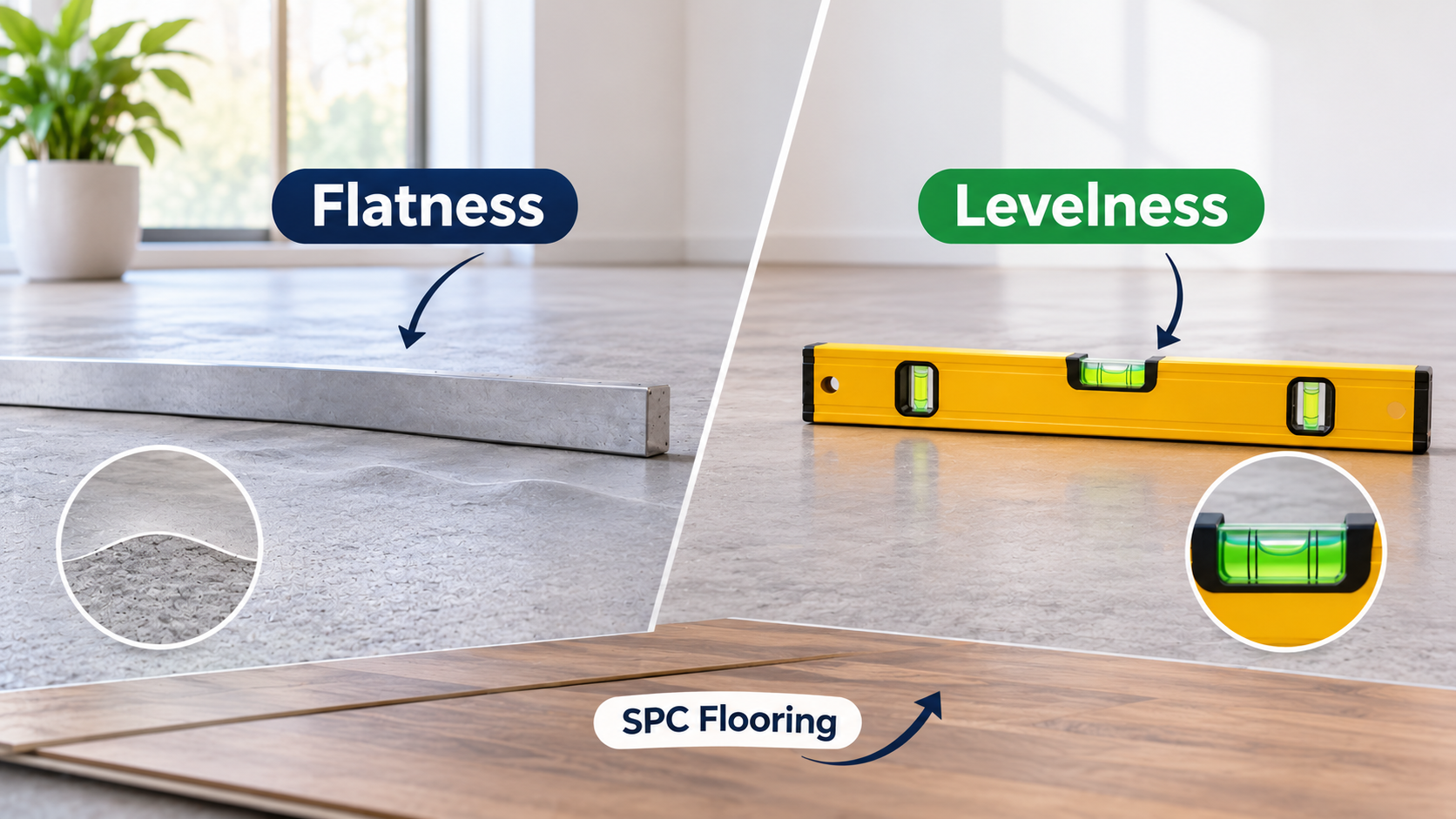
Flatness describes how smooth and even the surface is over a given distance. It focuses on local variations such as dips, humps, ridges and abrupt changes in height.
A subfloor can be relatively flat without being perfectly horizontal. For example, a floor may have a gentle, consistent slope while maintaining a smooth surface with no significant local irregularities.
For SPC flooring, flatness matters because the planks need continuous, appropriate support beneath them. Localised high points or depressions can create unsupported areas, allowing planks to flex under load or placing additional stress on the locking joints.
What Is Floor Levelness?
Levelness describes how close a surface is to a horizontal plane.
A level floor is horizontal within the relevant tolerance. However, a floor that is level at several measurement points may still contain small humps or depressions between those points.
Consider a concrete subfloor that measures at the same elevation near opposite walls but has a raised section in the middle. The overall measurements might suggest that the floor is level, yet the raised section can still interfere with flooring installation.
This distinction is important: a floor can be level but not flat, or flat but not level.
Why Flatness Usually Deserves Particular Attention With SPC Flooring
SPC flooring is commonly installed as a floating floor, with individual planks connected through a click-lock system rather than permanently fixed to the subfloor.
The installed floor behaves as an interconnected surface. When the substrate has excessive local variations, certain areas may receive more support than others.
Depending on the flooring design, installation conditions and severity of the irregularity, this may contribute to:
- Vertical movement or flexing when walked on.
- Increased stress on click-lock joints.
- Joint separation or damage over time.
- Audible movement or clicking underfoot.
- Gaps or other installation problems.
These outcomes are not inevitable. Their likelihood depends on factors such as the plank construction, locking-profile design, substrate condition, room layout and compliance with the manufacturer's installation instructions.
Correcting the substrate before installation is generally more effective than trying to resolve movement problems after the floor has been laid.
How to Assess Subfloor Flatness Before Installation
Subfloor assessment should take place before SPC flooring is installed, while any necessary preparation can still be completed.
1. Use a Suitable Straightedge
A straightedge of an appropriate length can help identify local high and low points. Place it across different parts of the subfloor and observe whether gaps appear beneath it or whether it rocks over a raised area.
The straightedge length and permitted gap should follow the flooring manufacturer's requirements. A visual check alone cannot establish compliance with every installation specification.
2. Check Multiple Directions
A floor may appear smooth when inspected in one direction but reveal a ridge or depression when checked across another.
Inspect the substrate in several directions, including across room entrances, along walls and through areas where different floor finishes meet.
3. Identify High and Low Areas
High spots may require suitable mechanical grinding, while low areas may need an appropriate levelling or patching compound.
The correct method depends on the substrate, the size and depth of the irregularity, and the preparation products approved for the installation.
4. Check for Other Subfloor Issues
Flatness is only one part of preparation. The installer should also consider substrate stability, cleanliness, moisture conditions and any cracks or defects that may affect the installation.
For concrete subfloors, moisture assessment should follow the requirements of the flooring manufacturer and the applicable test method. A visually dry surface does not necessarily establish that moisture conditions are acceptable.
How Much Flatness Is Required for SPC Flooring?
There is no single tolerance that should automatically be applied to every SPC product.
Permitted deviations can vary with the flooring manufacturer's installation instructions, the product construction, the measurement length and the relevant installation standard. A tolerance specified over a short straightedge distance may not be directly comparable with one measured over a longer distance.
Before installation, confirm:
- The manufacturer's maximum permitted subfloor deviation.
- The measurement method and straightedge length.
- The acceptable substrate type and preparation method.
- Any moisture-testing requirements.
- Whether underlay is permitted and which types are compatible.
Do not assume that a thicker SPC plank can compensate for an uneven substrate. Rigid-core flooring is not a substitute for proper subfloor preparation.
Can Underlay Correct an Uneven Floor?
Underlay can serve particular purposes, such as improving acoustic performance or providing a specified interface beneath compatible flooring products. However, it should not be treated as a general solution for substantial subfloor irregularities.
An unsuitable or excessively compressible underlay can affect how the planks are supported and may increase stress on the locking system. If the SPC product includes an attached backing, adding another layer without approval may also conflict with the manufacturer's instructions.
The correct approach is to prepare the substrate to the required tolerance and use only an underlay approved for that flooring system.
A Practical Example: Why the Difference Matters
Imagine a room with a concrete subfloor that is generally horizontal. During inspection, the installer discovers a raised ridge near the centre of the room.
Although the floor may appear level overall, the ridge prevents adjacent SPC planks from receiving consistent support. When someone walks over the affected area, the planks may move or flex, transferring stress to their connecting joints.
Installing the flooring without addressing the ridge can leave the installation vulnerable to problems. Correcting the high spot and rechecking the surface before laying the planks helps establish a more suitable base.
The lesson is simple: measuring overall height is not enough. The installer must also assess the surface profile.
The Bottom Line
Flatness and levelness describe different aspects of a subfloor. Levelness concerns its relationship to a horizontal plane, while flatness concerns local surface irregularities.
For SPC flooring, excessive local variations can affect support beneath the planks and place additional stress on the locking system. A proper pre-installation assessment should therefore verify the required flatness tolerance, investigate other substrate conditions and follow the specific flooring manufacturer's instructions.
A quality SPC installation begins beneath the planks. Getting the subfloor right is an essential part of achieving the intended performance of the finished floor.